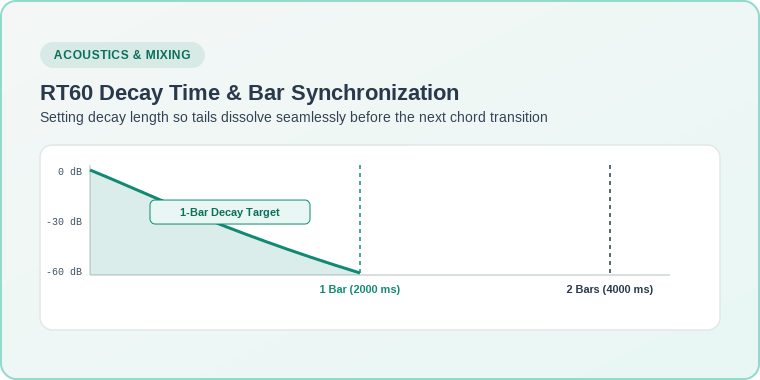
Understanding RT60 in Music Production
In classical architectural acoustics, RT60 represents the time (in seconds) required for an acoustic sound field to decay by 60 decibels after the sound source abruptly stops. In modern digital audio workstations and software reverb plugins (such as Valhalla VintageVerb, FabFilter Pro-R, Soundtoys Little Plate, or Lexicon 480L emulations), the Decay Time parameter controls this exact RT60 duration.
When decay time is set arbitrarily without regard to tempo, reverberant reflections from previous musical phrases spill over into subsequent transient hits. In dense arrangements, this tail overlap accumulates primarily in the 200 Hz to 500 Hz frequency range—the area audio engineers commonly refer to as the "mud zone" or "boxiness band." Calculating your reverb decay time to rhythmically align with the tempo of your song ensures that reflections naturally clear out before new harmonic content arrives.
Architectural Acoustics vs Digital Algorithmic Reverb: The Sabine Equation
In real physical spaces, reverberation time is not arbitrary; it is governed by Wallace Clement Sabine's foundational reverberation formula:
Sabine's Reverberation Formula
RT60 = 0.161 × V ÷ A
Where V is the room volume in cubic meters ($m^3$) and A is total acoustic absorption in metric sabins (the sum of all surface areas multiplied by their material absorption coefficients).
In software reverb design, algorithms simulate this physical behavior using complex Feedback Delay Networks (FDNs). The decay parameter determines the internal feedback multiplier of those interconnected delay lines. By intentionally tuning your digital RT60 to match musical measure lengths, you marry the architectural realism of physical room acoustics with the rhythmic momentum of modern production.
Mathematical Formulas for Bar-Synchronized Decay Times
Because reverb decay is measured in seconds rather than milliseconds, we compute beat duration using the standard time-base formula, then scale it across musical measures:
Beat duration in seconds:
Quarter Note (s) = 60 ÷ BPM
1 Bar (4 Beats in 4/4 Time):
1 Bar Decay (s) = (60 ÷ BPM) × 4 = 240 ÷ BPM
2 Bars (8 Beats in 4/4 Time):
2 Bar Decay (s) = (60 ÷ BPM) × 8 = 480 ÷ BPM
Half Note (2 Beats in 4/4 Time):
Half Note Decay (s) = (60 ÷ BPM) × 2 = 120 ÷ BPM
Worked Example at 120 BPM
At 120 BPM, a single beat lasts 60 ÷ 120 = 0.500 s (500 ms). A half note lasts 1.00 s. A 1-bar cycle lasts 2.00 s, and a full 2-bar cycle lasts 4.00 s. If your snare hits on beats 2 and 4, setting a 1-second decay time allows the snare's reverb tail to dissolve exactly as the next backbeat lands.
Decay Times Across Common Tempos
The table below provides reference decay targets calculated across major tempo brackets for standard 4/4 time:
| Tempo (BPM) | Quarter Note (1 Beat) | Half Note (2 Beats) | 1 Bar (4 Beats) | 2 Bars (8 Beats) |
|---|---|---|---|---|
| 80 BPM | 0.75 s (750 ms) | 1.50 s (1500 ms) | 3.00 s (3000 ms) | 6.00 s (6000 ms) |
| 90 BPM | 0.67 s (667 ms) | 1.33 s (1333 ms) | 2.67 s (2667 ms) | 5.33 s (5333 ms) |
| 100 BPM | 0.60 s (600 ms) | 1.20 s (1200 ms) | 2.40 s (2400 ms) | 4.80 s (4800 ms) |
| 110 BPM | 0.55 s (545 ms) | 1.09 s (1091 ms) | 2.18 s (2182 ms) | 4.36 s (4364 ms) |
| 120 BPM | 0.50 s (500 ms) | 1.00 s (1000 ms) | 2.00 s (2000 ms) | 4.00 s (4000 ms) |
| 128 BPM | 0.47 s (469 ms) | 0.94 s (938 ms) | 1.88 s (1875 ms) | 3.75 s (3750 ms) |
| 140 BPM | 0.43 s (429 ms) | 0.86 s (857 ms) | 1.71 s (1714 ms) | 3.43 s (3428 ms) |
| 160 BPM | 0.38 s (375 ms) | 0.75 s (750 ms) | 1.50 s (1500 ms) | 3.00 s (3000 ms) |
Instrument-Specific Reverb Decay Envelopes
Different elements of an arrangement require distinct spatial behaviors. Applying a single 3-second reverb across all instruments creates a cavernous wash that diminishes clarity. Here is how professional mix engineers tune decay times per instrument group:
1. Snare Drums & Percussive Transients
A snare drum in modern pop, rock, or hip hop acts as the rhythmic backbone. If the reverb decay outlasts the interval between beat 2 and beat 4, the initial transient of the next snare hit will be masked by existing reverberation. A half-note or dotted-quarter-note decay (0.5 s to 1.0 s at 120 BPM as a starting baseline) gives the snare impact and space without washing out subsequent hits.
2. Lead Vocals
Lead vocals require intelligibility and presence. A long decay time can cause trailing consonants to smear over incoming vocal phrases. Mixers often set a 1-bar or 1.5-bar decay time on a dedicated stereo auxiliary send, combined with a sidechain compressor or dynamic ducking plugin. When the vocalist sings, the reverb volume ducks by 2 to 4 dB; the moment the vocalist pauses between vocal phrases, the reverb tail blooms into the empty space in sync with the beat.
3. Acoustic Guitars & Piano
Acoustic instruments benefit from natural room or small hall emulations with decay times between 1.2 and 1.8 seconds. Setting the decay to terminate slightly before a chord change prevents dissonant note bleeding between distinct harmonic passages.
4. Synthesizer Pads & Ambient Textures
For background pads and atmospheric FX, 2-bar or 4-bar decay times (3.0 to 6.0 seconds) create expansive sonic depth. Because these elements occupy background layers, their long tails sustain musical energy without conflicting with upfront rhythmic transients.
Frequency-Dependent Decay Curves & Damping Calibration
In physical acoustics, sound reflections do not decay uniformly across all frequencies. Atmospheric air absorption and wall materials absorb high-frequency energy exponentially faster than low-frequency waves. To simulate realistic acoustic environments, professional reverb plugins feature High-Frequency Damping (HF Damping) and Low Multiplier Controls:
- High-Frequency Damping Crossover (3 kHz – 6 kHz): When sound travels through air, moisture absorbs high-frequency acoustic energy above 5 kHz. In your reverb plugin, set the HF damping crossover between 4 kHz and 6 kHz and reduce the high decay multiplier to 0.5×–0.7× of the main RT60. This causes treble shimmer to fade quickly, preventing brittle digital sibilance on vocal consonants and hi-hat splashes.
- Low-Frequency Decay Multiplier (Bass Damping): Low frequencies carry massive acoustic energy. If bass reflections decay at 1.0× or 1.2× the main RT60, the reverb tail will linger in the 150–300 Hz octave, suffocating your bassline and kick drum. Set the low decay multiplier to 0.7×–0.8× below 250 Hz to keep the low-end articulate and tight.
- Mid-Band RT60 Benchmark: Set your calculated bar-synchronized decay time as the baseline mid-frequency RT60. Let high and low frequencies decay slightly faster than this anchor, producing a warm, natural spatial decay.
Envelope Sculpting: Exponential Decay vs Non-Linear Tail Shape
Not all reverbs decay in a straight linear line. Modern mixing plugins offer envelope shaping parameters that alter the geometry of the reverb tail:
Natural Exponential Decay
Standard physical rooms exhibit exponential logarithmic decay (a steady decrease in decibels over time). This sounds organic, transparent, and seamless on acoustic instruments, pianos, and orchestral strings.
Non-Linear & Gated Envelopes
Non-linear algorithms maintain sustained, high-density reflection volume before abruptly cutting off (popularized by 1980s Phil Collins snare gated reverbs). Calculating exact gate hold and release times in milliseconds using our BPM to MS tool ensures the gate snaps shut cleanly on beat 3.
Calculate Custom Reverb Decay Times
Get exact 1-bar, 2-bar, half-note, and subdivision decay targets tailored to your track tempo using our dedicated calculator.
Open BPM Reverb Calculator →Frequently Asked Questions
How do I calculate reverb decay time from BPM?
Divide 240 by your tempo in BPM to determine the duration of 1 full bar in seconds: 240 ÷ BPM = 1 Bar Decay (s). For a 2-bar decay, divide 480 by BPM. For a half-note decay, divide 120 by BPM.
What is RT60 in audio plugins?
RT60 is the standard acoustic measurement of reverberation time. It defines the exact number of seconds required for a sound's reflections to drop by 60 decibels below its initial excitation volume.
Does pre-delay affect decay time?
Pre-delay and decay time are independent parameters, but they work together to shape perceived room size. Pre-delay delays the onset of the reverb tail, while decay time determines how long that tail persists once initiated. For maximum clarity, pair a tempo-synced pre-delay with a tempo-synced decay time.
Should reverb always be tempo-synced?
While tempo-syncing provides an invaluable baseline for punchy modern mixes, artistic discretion always applies. In ambient, classical, and shoegaze genres, deliberate non-tempo-synced decay times can create dreamy, ungrounded atmospheres.