Music Production Math & Mixing Guides
In-depth guides based on standard formulas for reverb timing, BPM calculations, vocal space, drum transients, and tempo-based mixing guides.
All Articles and Guides
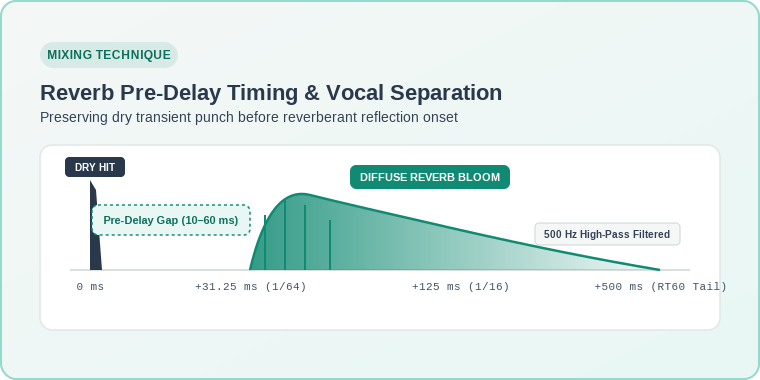
How to Set Reverb Pre-Delay: Depth Without Mud
Pre-delay is one of the most effective parameters for controlling soundstage placement. Learn how to calculate and dial in exact millisecond timings for vocals, drums, and instruments.
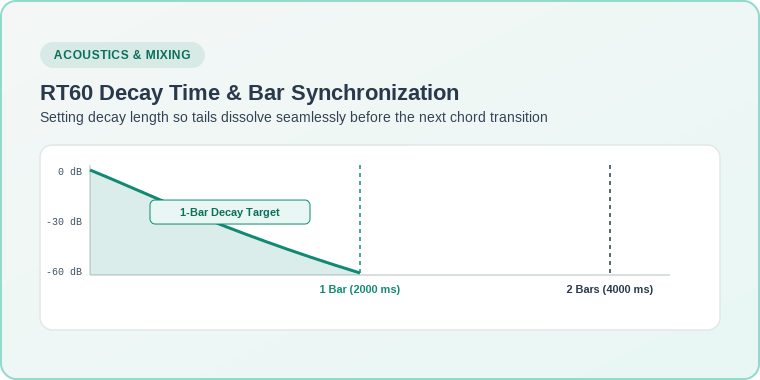
Reverb Decay Time & BPM: The Definitive Guide
A deep dive into calculating RT60 decay envelopes synchronized to musical tempo. Includes worked examples and strategies to prevent low-mid mix buildup.
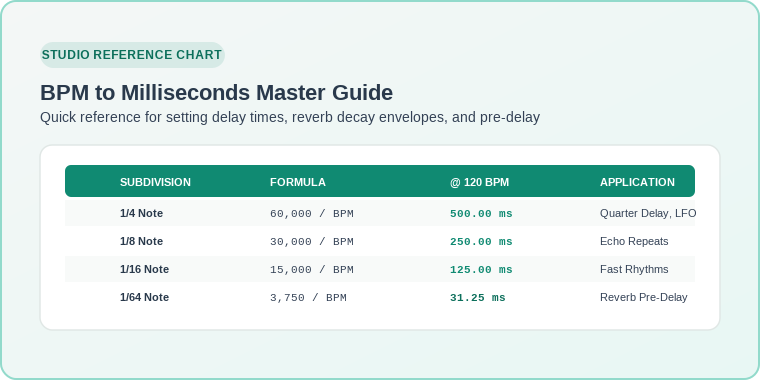
BPM to Milliseconds Chart for Music Producers
Complete master conversion chart and free printable 2-page A4 studio PDF covering tempos 60 to 180 BPM for quarter notes, eighths, sixteenths, dotted notes, and triplets.
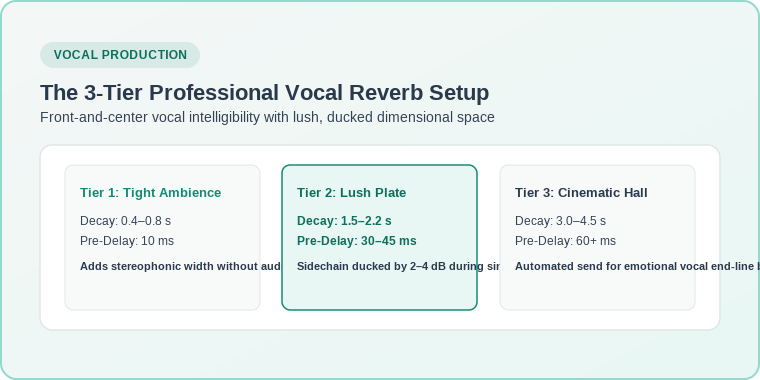
Reverb Settings for Vocals: Depth & Intelligibility
Professional vocal reverb settings: pre-delay calculation, decay times, Abbey Road EQ filtering, and sidechain ducking for modern radio-ready vocal tracks.
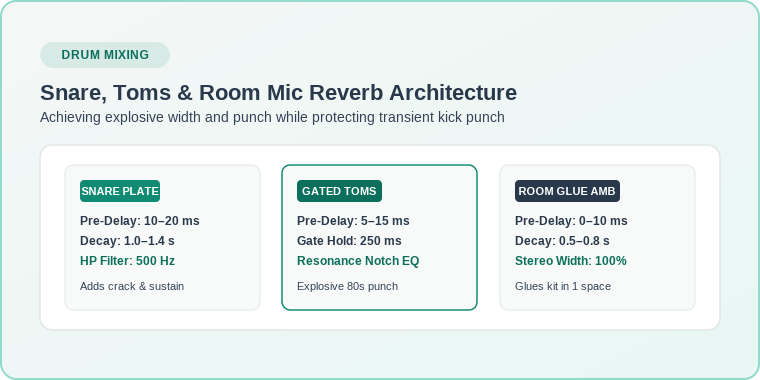
Reverb Settings for Drums: Snare, Toms & Room Mics
Calculate tempo-synced snare decay times, room ambience, low-frequency filtering, and explosive 80s gated reverb envelopes for punchy, dynamic drum kits.
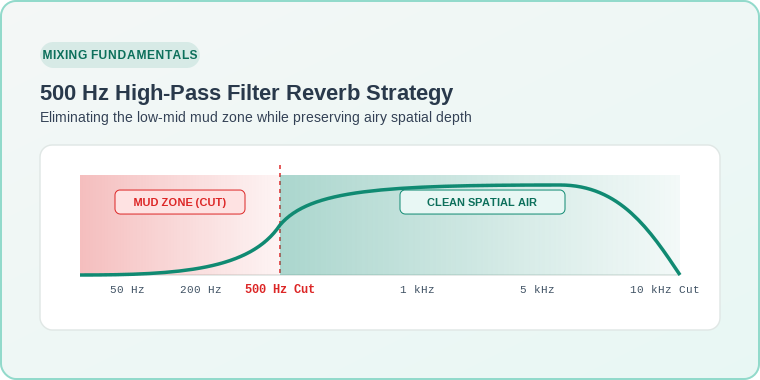
How to Avoid Muddy Reverb: 7 Proven Fixes
Fix muddy, washed-out reverb in your mixes with 7 actionable techniques: high-pass filtering, pre-delay expansion, mono reverb narrowing, and sidechain ducking.
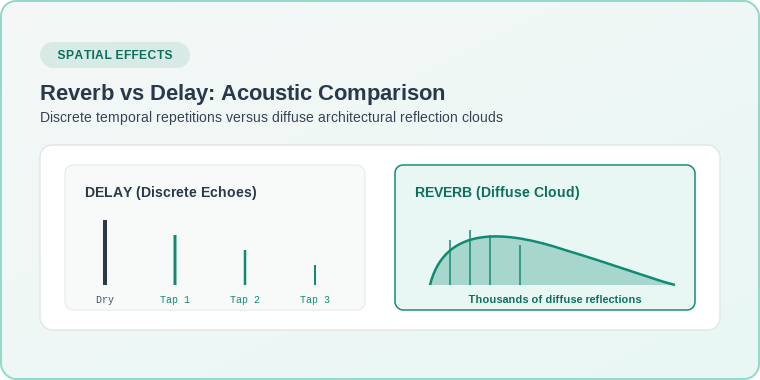
Reverb vs Delay: When to Use Each & How to Combine Both
Understand the acoustic physics and mix topology of reverb versus delay. Learn when delay provides cleaner depth and how to route delay into reverb in series.
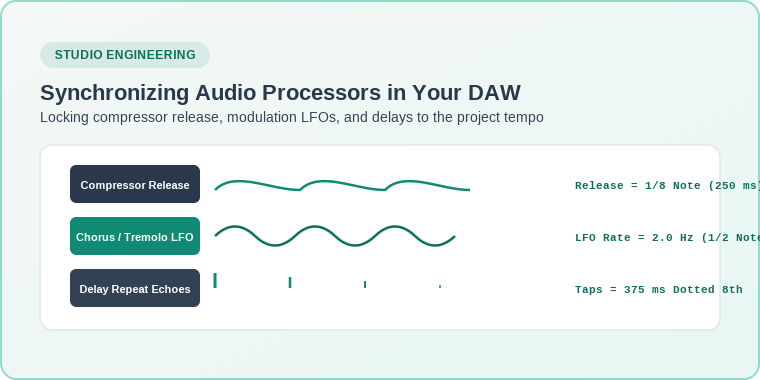
How to Sync Audio Effects to BPM: The Master Guide
Learn how to tempo-sync reverbs, delays, tremolos, phasers, chorus LFOs, and compressor release times using exact mathematical equations and conversion tables.
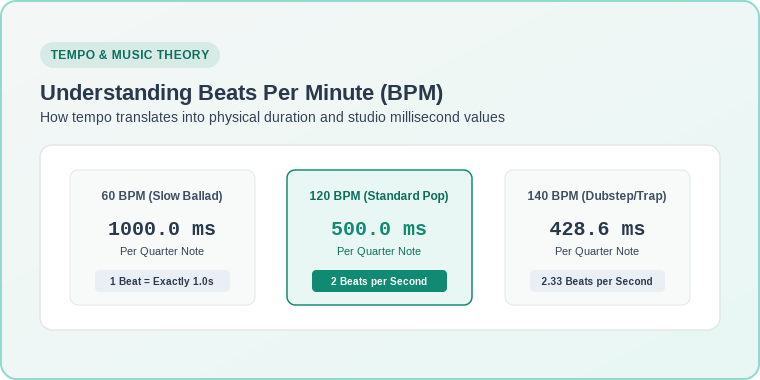
What Is BPM in Music? The Complete Guide to Tempo
Understand Beats Per Minute (BPM), tempo benchmarks across electronic and acoustic genres, and how tempo defines effect timing grids.
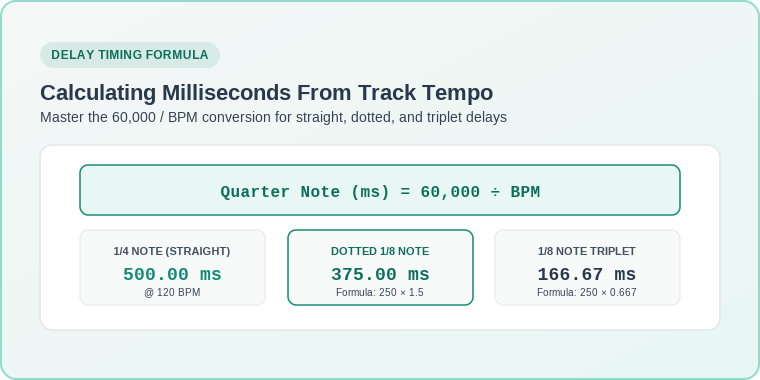
How to Calculate Delay Time From BPM
Step-by-step mathematical guide to calculating quarter note, dotted eighth, and triplet delay times in milliseconds from any tempo.
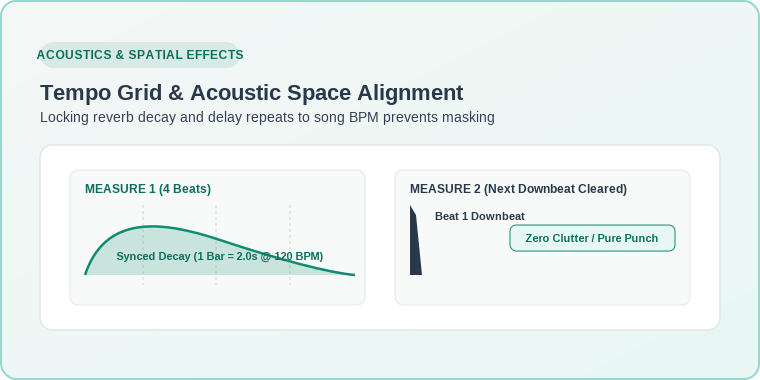
How BPM Affects Reverb and Delay in Audio Mixing
Discover how track tempo dictates reverb pre-delay, RT60 decay time, and delay repeat lengths to keep spatial effects transparent.
The Science of Time-Domain Effects in Modern Mixing
Spatial effects—primarily reverberation, delay, chorus, and modulation—define the depth, dimension, and physical reality of a recorded production. However, in modern multi-track sessions containing dozens of synthesized and acoustic layers, spatial effects can quickly transform from lush acoustic enhancements into dense low-mid clutter. Our mixing guides explain the mathematical and acoustic principles of tempo synchronization to help you achieve clear, balanced spatial depth.
1. The Mathematical Foundation
Every rhythmic subdivision is governed by the universal constant 60,000 ÷ BPM. When you calculate pre-delay, decay times (RT60), and compressor release curves to align with musical measures, your spatial tails dissolve into silence right as the next transient arrives, preserving punch and headroom.
2. Frequency Separation (Abbey Road Filtering)
Reverberating frequencies below 500 Hz floods the low-mid "mud zone," masking basslines and kick transients. High-passing reverb aux returns at 500–600 Hz and low-passing above 8–10 kHz keeps the spatial halo warm and focused without clashing with lead vocals or cymbals.
3. The 3-Dimensional Mix Soundstage
Mixing in 3D requires balancing the Z-axis (Depth via pre-delay and wet/dry ratios), X-axis (Width via stereo ping-pong and Haas micro-delays), and Y-axis (Height via frequency filtering). Discover how our step-by-step guides help you place each instrument in its own defined spatial pocket.
4. Dynamic Sidechain Ducking
Modern pop and hip-hop vocals demand colossal, 3-second reverb tails without sacrificing upfront syllable intelligibility. By ducking the reverb return 3–6 dB during active vocal lines, the reverb gracefully breathes back in between phrases without clouding lyrics.
Universal DAW & Outboard Hardware Integration
Whether you produce in Avid Pro Tools, Apple Logic Pro, Ableton Live, FL Studio, Steinberg Cubase, or Studio One, spatial principles remain identical. Furthermore, many vintage delay and tape units have no tempo sync, so their delay times are set manually in milliseconds. Our guides and calculation tables provide the exact millisecond values you need to type into hardware parameter displays or dial into software plugins.
All tutorials and guides are created by Nadir Hussain to explain the core mathematical relationships of tempo-synced mixing and provide practical parameter starting points for your sessions.
Explore Our Free Studio Calculation Suite
Put these techniques into practice immediately with our suite of dedicated audio calculators. Calculate instant pre-delays and tempo-locked decay times with our master BPM Reverb Calculator, sync echo throws with the BPM Delay Calculator, or convert tempos with our BPM to Milliseconds Calculator.