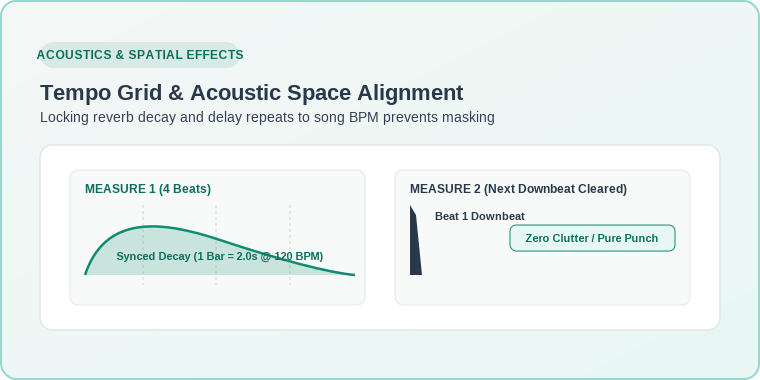
The Relationship Between Musical Tempo and Acoustic Space
In physical architecture, a room's acoustics are governed by volume, wall surface geometry, and material absorption coefficients (expressed through the classical Sabine RT60 equation). In music production, however, acoustic space must coexist with the rhythmic dimension of musical time: Beats Per Minute (BPM).
When you insert a reverb or delay plugin onto a track, you introduce temporal energy that lingers after the initial instrument note has stopped sounding. If that lingering energy decays in disharmony with the underlying tempo, the mix quickly suffers from frequency masking, smeared transients, and lost punch. Understanding how tempo dictates spatial timing is the key to creating expansive yet articulate mixes.
1. Fast Tempos vs. Slow Tempos: The Available Space Dilemma
The most immediate way BPM impacts your spatial processing is through measure duration. Consider the drastic mathematical difference in measure length across genres:
- Slow Ballad / R&B (70 BPM): One quarter note equals 857.1 ms, and a standard 4/4 bar lasts 3.43 seconds. Because there is abundant temporal space between musical phrases, vocals and guitars can comfortably breathe inside large plate or concert hall reverbs with 2.5 to 3.2 second RT60 decay tails without obscuring the next beat.
- Mid-Tempo Pop / House (120–128 BPM): One quarter note equals 500.0 to 468.8 ms, and a full measure lasts only 1.87 to 2.00 seconds. A 3-second reverb tail would spill across an entire bar and a half, continuously muddying the kick and bass groove. Reverb decays here should typically sit between 1.0 and 1.8 seconds (matching 2 to 4 beats).
- Fast EDM / Drum & Bass / Punk (160–174 BPM): A 4/4 measure flashes by in just 1.38 to 1.50 seconds, with quarter notes clocking 344.8 to 375.0 ms. Long ambient tails instantly destroy groove definition. Mixes at these tempos rely on short ambiences, tight room reflections (0.3 to 0.7 s RT60), or ducked delays to preserve high-velocity transient impact.
2. The Available Temporal Window by Tempo (60 to 180 BPM)
To visualize how available mix space shrinks as tempo accelerates, examine the exact duration of measures and note intervals in milliseconds across common production tempos:
| Tempo (BPM) | 1 Bar (4 Beats) | Quarter Note (1 Beat) | 8th Note Window | 16th Note Window | Max Usable Reverb Decay |
|---|---|---|---|---|---|
| 60 BPM | 4,000.0 ms | 1,000.0 ms | 500.0 ms | 250.0 ms | 3.0 – 4.0 s (Cathedral / Hall) |
| 75 BPM | 3,200.0 ms | 800.0 ms | 400.0 ms | 200.0 ms | 2.4 – 3.2 s (Large Plate) |
| 90 BPM | 2,666.7 ms | 666.7 ms | 333.3 ms | 166.7 ms | 1.8 – 2.4 s (Medium Hall) |
| 105 BPM | 2,285.7 ms | 571.4 ms | 285.7 ms | 142.9 ms | 1.5 – 2.0 s (Warm Plate) |
| 120 BPM | 2,000.0 ms | 500.0 ms | 250.0 ms | 125.0 ms | 1.2 – 1.8 s (Studio Room) |
| 128 BPM | 1,875.0 ms | 468.8 ms | 234.4 ms | 117.2 ms | 1.0 – 1.5 s (Tight Chamber) |
| 140 BPM | 1,714.3 ms | 428.6 ms | 214.3 ms | 107.1 ms | 0.8 – 1.2 s (Percussion Ambience) |
| 160 BPM | 1,500.0 ms | 375.0 ms | 187.5 ms | 93.8 ms | 0.5 – 0.9 s (Short Room) |
| 174 BPM | 1,379.3 ms | 344.8 ms | 172.4 ms | 86.2 ms | 0.3 – 0.7 s (Micro Ambience) |
3. Psychoacoustic Masking & Auditory Crowding at Fast Tempos
Human hearing does not process sound continuously in real time; the brain integrates incoming acoustic energy over small temporal integration windows (approximately 20 to 40 milliseconds). In acoustic psychoacoustics, this phenomenon causes auditory masking:
- Forward Masking: A loud transient (such as an aggressive snare crack) temporarily desensitizes the ear to quieter sounds occurring up to 50–100 ms afterward.
- Temporal Crowding: At 174 BPM, sixteenth-note hi-hat hits or bass stabs occur every 86.2 ms. If a snare reverb has an un-synchronized 1.5-second tail, that diffuse reverberant energy washes over 17 distinct subsequent sixteenth-note events! The listener's brain cannot separate the dry rhythmic transients from the reverberant noise floor, resulting in what mix engineers describe as a "washed out" or "distant" mix.
- Low-Mid Resonance Buildup: Because lower frequencies take longer to complete full sound wave cycles (a 100 Hz wave takes 10 ms per cycle; a 50 Hz wave takes 20 ms), lingering reverb tails in the 200–500 Hz region overlap exponentially faster at high tempos, creating muddy acoustic clutter.
4. Pre-Delay and Transient Preservation
Pre-delay represents the silent gap in milliseconds between the dry direct signal and the first reflection hitting the virtual boundaries. In human psychoacoustics, when two sounds occur within 0 to 20 ms of each other, the brain fuses them into a single perceived sound event (the Haas effect).
If your reverb pre-delay is set to 0 ms, the reverb onset immediately attacks at the exact same instant as the dry vocal consonant or snare transient, softening its punch. By calculating pre-delay as a tempo-synced musical fraction—such as a 1/32nd note or 1/64th note using our Pre-Delay Calculator—you carve out a dedicated window of clean air. The dry sound punches cleanly through the monitors first, followed rhythmically by the rich bloom of the reverb.
5. Delay Synchronization and Rhythmic Cohesion
Unlike diffuse reverberation, delay produces distinct, repeating echoes. When delay repeats do not match the tempo grid, their rhythmic pulses clash with the drummer's hi-hats, percussion swing, and bass rhythm. Syncing delays to exact metrical subdivisions (1/4, 1/8, or dotted 1/8d) reinforces the track's groove while adding stereo dimension. Use our BPM Delay Calculator to look up millisecond intervals across any tempo.
In fast or dense arrangements where reverb threatens to overwhelm headroom, replacing reverb with tempo-synced delay is a premier mixing secret. An eighth-note or dotted-eighth delay provides spatial depth and stereo spread, but leaves silent gaps between repeats where dry instruments can punch through unimpeded.
6. Spatial Effect Targets by Tempo Category
| Tempo Range | Genre Examples | Recommended Pre-Delay | Optimal Reverb Decay | Preferred Delay Sync |
|---|---|---|---|---|
| Slow (60–85 BPM) | R&B, Trap Ballads, Ambient, Soul | 30–60 ms (1/32 note) | 2.0–3.5 s (Large Hall / Plate) | 1/4 note, 1/8 note (long repeats) |
| Medium (90–124 BPM) | Pop, Hip-Hop, House, Indie Rock | 15–35 ms (1/64 note) | 1.2–2.2 s (Big Room / Medium Hall) | Dotted 1/8 note (syncopated throw) |
| Fast (128–175 BPM) | EDM, Techno, Drum & Bass, Metal | 5–18 ms (Short 1/64 note) | 0.4–1.0 s (Tight Ambience / Small Room) | 1/16 note, 1/8 triplet (tight slap) |
7. 5-Step Workflow for Tight, Musical Spatial Mixing
- Calculate Your Quarter Note Base: Divide 60,000 ÷ BPM using our BPM to Milliseconds Tool.
- Set Pre-Delay to Protect Consonants: For vocals and snares, set pre-delay to a 1/32nd or 1/64th note value to preserve pristine transient attack.
- Tune Decay Time to Fade Before Major Hits: Adjust reverb decay so the tail falls below the noise floor right before the next snare strike or vocal phrase. Use the Reverb Decay Calculator.
- Filter the Reverb Returns: High-pass the reverb send at 500–600 Hz to eliminate muddy sub-bass rumble, and low-pass at 8–10 kHz to tame harsh sibilance.
- Automate Space Across Song Sections: Keep verse reverbs tight and dry (0.8–1.2 s decay), then automate decay times or delay send levels upward on the chorus downbeat to create dynamic impact without cluttering intimate lyrical passages.
Calculate Exact Reverb Decay Times
Determine exact 1-bar, 2-bar, and subdivision decay times in milliseconds tailored to your session's BPM.
Open BPM Reverb Calculator →Frequently Asked Questions
Should reverb decay always match exact tempo subdivisions?
Not strictly. Musical timing provides an ideal initial mathematical target so tails breathe with the beat, but arrangement density, instrumentation, and artistic taste should always govern final fine-tuning.
Why do fast songs often sound better with delay instead of reverb?
Because delay repeats leave empty space between echoes, whereas reverb continuously fills all silence with diffuse acoustic energy. At fast tempos, delay provides depth without smearing fast drum transients.
How do I calculate pre-delay from track tempo?
Divide 60,000 by your session BPM to find the quarter-note duration in milliseconds. Then divide by 16 for a 1/64-note pre-delay, or divide by 32 for a 1/128-note pre-delay.
What is the risk of having unsynced delay repeats in a mix?
Unsynced delay repeats clash with the natural groove of the drums and rhythm section, creating confusing polyrhythms and masking lead transients instead of enhancing spatial width.