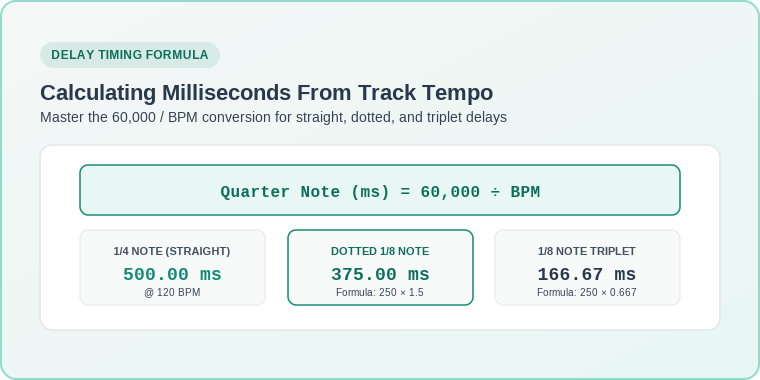
The Core Delay Formula Explained
In audio engineering, musical tempo is measured in Beats Per Minute (BPM), while digital audio processors, analog tape echoes, and outboard delay racks measure repeat intervals in milliseconds (ms). To synchronize any delay effect with your track's tempo, you must determine how many milliseconds elapse during one beat (a quarter note).
Because there are 60 seconds in one minute and 1,000 milliseconds in one second, every minute contains exactly 60,000 milliseconds (60 × 1,000 = 60,000). Dividing this 60,000-millisecond constant by your session's BPM yields the exact duration of a quarter note:
Quarter Note Delay (ms) = 60,000 ÷ BPM
Example at 120 BPM: 60,000 ÷ 120 = 500.0 ms per quarter note beat.
Example at 140 BPM: 60,000 ÷ 140 = 428.6 ms per quarter note beat.
Calculating Musical Note Subdivisions
Once you know the quarter-note duration, every other musical subdivision can be calculated using simple multipliers:
- Half Note (1/2): Multiply quarter note ms by
2.0. At 120 BPM:500 × 2.0 = 1,000 ms. Used for wide, cavernous ambient delays and half-time synth pads. - Eighth Note (1/8): Multiply quarter note ms by
0.5. At 120 BPM:500 × 0.5 = 250 ms. A staple for classic rhythmic echoes that lock directly into the rhythm section. - Dotted Eighth Note (1/8d): Multiply eighth note ms by
1.5(or quarter note by0.75). At 120 BPM:500 × 0.75 = 375 ms. This creates the signature syncopated rhythmic gallop made famous by The Edge (U2), Pink Floyd, and modern EDM synth leads. - Sixteenth Note (1/16): Multiply quarter note ms by
0.25. At 120 BPM:500 × 0.25 = 125 ms. Perfect for rockabilly vocal slapbacks, snare fattening, and rhythm guitar doubling. - Eighth Triplet (1/8t): Multiply quarter note ms by
0.3333(or divide by 3). At 120 BPM:500 ÷ 3 = 166.7 ms. Essential for swing, shuffle, blues, and triplet trap hi-hat patterns. - Thirty-Second Note (1/32): Multiply quarter note ms by
0.125. At 120 BPM:500 × 0.125 = 62.5 ms. Ideal for subtle spatial thickening and Haas effect stereo widening without audible discrete repeats.
Feedback Mathematics: Calculating Audible Repeats & Total Tail
While the delay time controls the spacing between echoes, the Feedback parameter controls how many times the echo repeats before decaying below the threshold of human hearing (-60 dB, the standard acoustic RT60 threshold). Feedback is expressed as a percentage of the output signal fed back into the delay line.
Every time an echo recirculates, its amplitude is multiplied by the feedback fraction. The number of audible repeats (N) until the signal decays by 60 dB can be calculated using the logarithmic attenuation formula:
Audible Repeats to -60 dB = -60 ÷ [20 × log10(Feedback % ÷ 100)]
Example at 50% Feedback: 20 × log10(0.50) = -6.02 dB per repeat. Therefore: -60 ÷ -6.02 ≈ 10 audible repeats.
| Feedback Setting (%) | Attenuation per Repeat (dB) | Audible Echo Repeats (-60 dB) | Total Duration at 120 BPM (1/8 Note: 250 ms) |
|---|---|---|---|
| 10% | -20.0 dB | 3 repeats | 750 ms (0.75 s) |
| 25% | -12.0 dB | 5 repeats | 1,250 ms (1.25 s) |
| 50% | -6.0 dB | 10 repeats | 2,500 ms (2.50 s) |
| 65% | -3.7 dB | 16 repeats | 4,000 ms (4.00 s) |
| 70% | -3.1 dB | 19 repeats | 4,750 ms (4.75 s) |
| 85% | -1.4 dB | 43 repeats | 10,750 ms (10.75 s) |
Knowing this formula enables you to calculate the exact Total Echo Duration: Total Duration = Delay Time (ms) × Number of Repeats. For an 1/8-note delay at 120 BPM (250 ms), 50% feedback yields about 10 repeats (60 ÷ 6.02 dB ≈ 10 repeats × 250 ms = 2,500 ms / 2.5 s). To keep a vocal delay throw echoing across 2 bars (4,000 ms) before the next section arrives, setting feedback to about 65% produces roughly 16 repeats (-20 × log10(0.65) ≈ 3.74 dB attenuation per repeat; 60 ÷ 3.74 dB ≈ 16 repeats × 250 ms = 4,000 ms / 4.0 s).
The 4 Classic Delay Configurations in Modern Mixing
Depending on how you configure delay times and feedback, delay can perform four completely distinct acoustic roles in your session:
1. Slapback Echo (40–120 ms, Low Feedback)
A single rapid repetition (0–15% feedback) that fattens lead vocals, guitar solos, and snare hits. Originating from Sun Studio tape machines in the 1950s, modern producers use a 1/16th-note or 1/32nd-note delay to give vocals thickness and analog attitude without creating washed-out reverb mud.
2. The Dotted Eighth Gallop (0.75× Beat)
The most iconic rhythmic delay in music history. Playing straight eighth-note guitar plucks or synth arpeggios through a dotted eighth delay (e.g. 375 ms at 120 BPM) creates an interlocking sixteenth-note counter-rhythm. It transforms sparse chords into dense, driving rhythmic textures.
3. Ping-Pong Stereo Width Delay
By offsetting left and right delay times (for example, Left = 1/8 note [250 ms], Right = Dotted 1/8 note [375 ms]), the repeats bounce back and forth across the stereo panorama. This creates enormous stereo dimension while keeping the center channel clear for lead vocals, kick, and bass.
4. Ducked Quarter-Note Vocal Throw
A dramatic delay (1/4 or 1/2 note with 40–60% feedback) placed on an auxiliary send and sidechained to the lead vocal. While the singer is actively singing, the delay ducks by 4–6 dB. When the singer finishes a lyrical phrase, the delay swells into the empty gap, creating professional radio depth without syllable masking.
Why Manual Millisecond Calculation Still Matters
While modern software plugins often feature a DAW host-sync button, mastering manual millisecond calculation remains an indispensable skill for professional audio engineers for several critical reasons:
- Hardware Outboard Gear: Many vintage delay and tape units have no tempo sync, so their delay times are set manually in milliseconds.
- Micro-Timing and Groove Feel: Exact mathematical sync can occasionally sound overly rigid or sterile. By knowing the exact grid value (e.g. 250 ms), an engineer can intentionally nudge the delay by +5 ms (to create a laid-back, dragging feel) or -10 ms (to create an energetic, pushing feel) without losing the tempo relationship.
- Synthesizer LFOs and Modulation: Many modular synths and hardware synthesizers feature free-running LFO rates calibrated in Hz or milliseconds. Calculating timing allows you to lock filter sweeps and tremolo speeds to your song's pulse.
Studio Delay Quick Reference Chart
The table below provides instantly usable millisecond timings across five of the most common production tempos:
| Tempo (BPM) | 1/4 Note (ms) | Dotted 1/8 (ms) | 1/8 Note (ms) | 1/16 Note (ms) | 1/8 Triplet (ms) |
|---|---|---|---|---|---|
| 80 BPM | 750.0 ms | 562.5 ms | 375.0 ms | 187.5 ms | 250.0 ms |
| 100 BPM | 600.0 ms | 450.0 ms | 300.0 ms | 150.0 ms | 200.0 ms |
| 120 BPM | 500.0 ms | 375.0 ms | 250.0 ms | 125.0 ms | 166.7 ms |
| 128 BPM | 468.8 ms | 351.6 ms | 234.4 ms | 117.2 ms | 156.3 ms |
| 140 BPM | 428.6 ms | 321.4 ms | 214.3 ms | 107.1 ms | 142.9 ms |
Auxiliary Send Routing & The Delay Filtering Trick
To preserve mixing flexibility, always place your delay plugin on a dedicated Auxiliary Return Track (Bus) with Mix set to 100% Wet. Send signal from your dry tracks via auxiliary sends. This enables you to filter and sculpt the delay repeats independently of the dry recording:
- High-Pass Filter at 400–500 Hz: Eliminates muddy low-end buildup, preventing delayed echoes from conflicting with basslines, kick drum transients, and vocal fundamentals.
- Low-Pass Filter at 4–5 kHz: Softens harsh sibilant 's' consonants and pick attacks. In real acoustic spaces, distant echoes naturally lose high frequencies due to air friction. Filtering high frequencies pushes the delay repeats backward in the virtual soundstage.
- Subtle Analog Tape Saturation: Inserting a tape emulation plugin before or after the delay softens the transients of each repeat, allowing them to melt organically into the mix.
Starting Point Note: These 400–500 Hz high-pass and 4–5 kHz low-pass values are general starting points specifically for delay returns, not reverb returns. While reverb returns typically use broader filters (such as high-passing at 500–600 Hz and low-passing at 8–10 kHz) to preserve diffuse space, delay returns benefit from narrower bandpass shaping so discrete rhythmic echoes tuck cleanly behind the lead sound.
Calculate Custom Delay Times in Seconds
Skip manual calculator math! Use our interactive BPM Delay Calculator to generate straight, dotted, and triplet millisecond values for any session tempo.
Open BPM Delay Calculator →Frequently Asked Questions
Why is 60,000 used as the constant in delay formulas?
Because tempo is measured per minute, and delays are measured in milliseconds. There are 60 seconds in a minute, and 1,000 milliseconds in a second (60 × 1,000 = 60,000).
How do I set up a ping-pong stereo delay using calculated times?
Set the left delay channel to an eighth note (e.g. 250 ms at 120 BPM) and the right delay channel to a dotted eighth note (375 ms). The alternating rhythm creates wide, dynamic stereo movement without phase cancellation.
What is the best delay time for lead vocals?
A dotted 1/8 note delay is the most versatile setting for lead vocals in pop, rock, and electronic music because its syncopated repeats land squarely between the quarter-note beats of the track.
How do I calculate triplet and dotted delay times?
For a dotted note, multiply the straight note millisecond value by 1.5. For a triplet note, multiply the straight note value by 0.667 (or divide by 1.5).