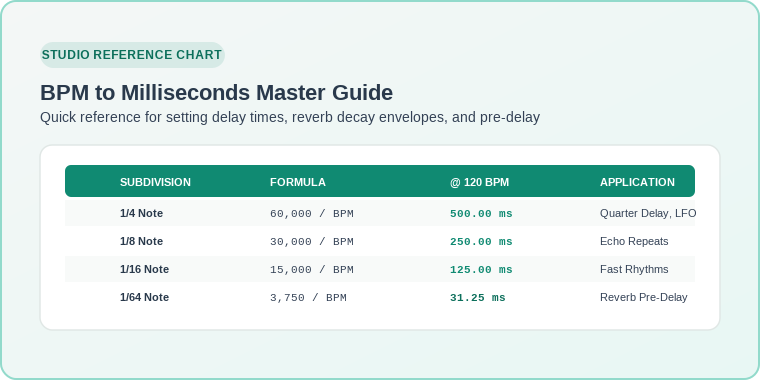
The Core Equation
Because there are 60 seconds (60,000 milliseconds) in a minute, one quarter note (1 beat in 4/4 time) is calculated as:
Quarter Note (ms) = 60,000 ÷ BPM
Every other musical timing subdivision is a direct derivative of this core interval. Halving the result produces eighth notes, halving again gives sixteenth notes, and multiplying by 1.5 yields dotted values that lock perfectly into your session grid.
Master Tempo-to-MS Reference Table
Below is a quick reference conversion table spanning common music production tempos between 70 and 174 BPM:
| BPM | 1/4 Note (ms) | 1/8 Note (ms) | 1/16 Note (ms) | Dotted 1/8 (ms) | 1/8 Triplet (ms) |
|---|---|---|---|---|---|
| 70 | 857.14 | 428.57 | 214.29 | 642.86 | 285.71 |
| 80 | 750.00 | 375.00 | 187.50 | 562.50 | 250.00 |
| 90 | 666.67 | 333.33 | 166.67 | 500.00 | 222.22 |
| 100 | 600.00 | 300.00 | 150.00 | 450.00 | 200.00 |
| 110 | 545.45 | 272.73 | 136.36 | 409.09 | 181.82 |
| 120 | 500.00 | 250.00 | 125.00 | 375.00 | 166.67 |
| 124 | 483.87 | 241.94 | 120.97 | 362.90 | 161.29 |
| 128 | 468.75 | 234.38 | 117.19 | 351.56 | 156.25 |
| 130 | 461.54 | 230.77 | 115.38 | 346.15 | 153.85 |
| 140 | 428.57 | 214.29 | 107.14 | 321.43 | 142.86 |
| 150 | 400.00 | 200.00 | 100.00 | 300.00 | 133.33 |
| 160 | 375.00 | 187.50 | 93.75 | 281.25 | 125.00 |
| 174 | 344.83 | 172.41 | 86.21 | 258.62 | 114.94 |
Download the Full BPM-to-MS Studio Reference Chart (PDF)
Need a comprehensive physical reference for your studio desk or outboard console? Download our free, print-optimized 2-page A4 reference sheet. It includes the complete timing grid covering 60 to 180 BPM across 7 key subdivisions (1/4, 1/8, 1/8d, 1/16, 1/4d, 1/8t, and 1/4t), complete mathematical formula derivations, 4 worked benchmark examples (90, 120, 128, 140 BPM), and acoustic mixing guidance for reverb pre-delay and compressor release.
Where to Apply Millisecond Values in Modern Mixing
Understanding precise millisecond values transforms how you control time-domain processors. Modern mixing is built on rhythmic micro-timings. Here is how professional mix engineers apply millisecond values across dynamic, spatial, and modulation processors:
1. Rhythmic Compressor Release Calibration
A common cause of a lifeless or "choked" mix is compressor release times that fight against the groove. When audio compressors (such as an SSL G-Master Bus Compressor, Neve 33609, Empirical Labs Distressor, or 1176LN) clamp down on a snare or drum bus hit, the release parameter dictates how quickly the gain reduction returns to unity.
If the release is set too fast, the compressor introduces audible low-frequency distortion and aggressive pumping. If the release is set too slow, the compressor is still attenuating when the next transient arrives, crushing punch and dynamic impact. By calculating the duration of an 8th note or 16th note, you can set the release envelope so the gain reduction meter snaps cleanly back to zero decibels immediately before the subsequent backbeat lands.
1/16 Note Duration = 60,000 ÷ 120 ÷ 4 = 125 ms
// Setting release slightly below 125 ms (e.g. 100–115 ms) guarantees full recovery before the next 16th note hit
2. Outboard Vintage Delay Units & Analog Tape Machines
Many vintage delay and tape units have no tempo sync, so their delay times are set manually in milliseconds. Producers enter millisecond values into the digital readout or tune tape motor speeds using millisecond calculations.
For example, dialing in a vintage slapback echo on a rockabilly or indie vocal requires a tight 1/16th or 1/32nd note delay. At 130 BPM, dialing exactly 115.38 ms creates authentic tape slapback that stays perfectly locked to the drum pocket without creating rhythmic dissonance.
3. Synchronizing LFO Rates & Modulation Frequencies (Hz to MS)
Modulation effects such as chorus, flangers, phasers, rotary speakers, and auto-pan plugins frequently offer their rate parameters in Hertz (cycles per second) rather than musical note subdivisions. Because frequency ($f$) and period ($T$) are inversely related, you can easily translate tempo-synced milliseconds into exact Hertz values using the formula:
// Example: Quarter Note at 120 BPM (500 ms)
Quarter Note LFO Rate = 1,000 ÷ 500 = 2.00 Hz
// Example: 1 Bar LFO Sweep at 120 BPM (2,000 ms)
1 Bar Filter Sweep = 1,000 ÷ 2,000 = 0.50 Hz
Setting your auto-pan or synth filter LFO to precisely 0.50 Hz at 120 BPM creates a sweeping stereo motion that completes exactly one full cycle across every measure of 4/4 time.
4. Gated Snare Reverb & Noise Gate Envelopes
In 80s synthwave, modern arena rock, and electronic pop, gated snare reverb creates massive sonic impact without cluttering the mix. To achieve this, a dense plate or non-linear digital room reverb is inserted on an aux return, followed immediately by a noise gate. The noise gate's Hold Time must be calculated to sustain for exactly a 16th note or 8th note duration before abruptly closing.
At 100 BPM, a 16th note lasts 150 ms. Setting the noise gate hold to 150 ms and release to 30 ms allows the reverb to explode at full volume across the sixteenth-note window, then instantaneously disappear before the kick drum or hi-hat sounds.
Compressor Topologies: Opto, VCA & FET Release Timing
Understanding note durations in milliseconds is critical when configuring analog compressor circuits, which vary wildly in their dynamic response envelopes:
| Compressor Circuit | Typical Attack Speed | Typical Release Window | Musical Subdivision Application |
|---|---|---|---|
| VCA (e.g. SSL G-Master, API 2500) | 0.1 ms to 30 ms (Stepped) | 100 ms to 1,200 ms (or Auto) | Set to 1/8 note (250 ms at 120 BPM) for punchy drum bus groove and glue. |
| Opto (e.g. Teletronix LA-2A) | ~10 ms (Fixed light panel) | Multi-stage: 60 ms initial, up to 5s tail | Naturally tracks 1/2 note to 1-bar ballad phrases without manual calibration. |
| FET (e.g. UREI 1176LN) | 20 to 800 microseconds | 50 ms to 1,100 ms | Set release to 7 (fastest ~50 ms, roughly 1/32 note) for explosive snare transient bite. |
| Vari-Mu Tube (e.g. Fairchild 670) | 0.2 ms to 0.4 ms | 300 ms to 5,000 ms (Time constants) | Select Time Constant 1 (300 ms) for 1/8-note midtempo bus leveling. |
Mathematical Breakdown of Dotted and Triplet Values
Music is rarely limited to straight binary divisions. Rhythmic swing, shuffle grooves, and syncopated sync depend on dotted and triplet values:
- Dotted Values (1.5 × Base): A dotted note adds half the duration of the original note value (Base × 1.5). Dotted eighth-note delays (1/8d) are common for lead guitars (the famous U2/The Edge rhythmic delay) and pop vocal throws because the repeats fall symmetrically into the offbeat spaces between quarter-note downbeats.
- Triplet Values (0.6667 × Base): A triplet fits three notes into the space normally occupied by two notes (Base × 2/3 or Base × 0.6667). Triplet delays (1/8t or 1/16t) are used when mixing swing jazz, hip-hop shuffle beats, trap hi-hat rolls, and UK garage.
Calculate Custom Tempos Instantly
Need exact timing for fractional tempos or specialized subdivisions? Visit our full suite of interactive timing calculators to dial in your hardware and software effects with mathematical accuracy:
Need Instant Precise Millisecond Calculations?
Compute exact millisecond values, dotted notes, triplets, and frequency rates for any custom BPM or fractional tempo in real time.
Open BPM to Milliseconds Calculator →Frequently Asked Questions
How do you convert BPM to milliseconds manually?
Divide 60,000 by your track's BPM to find the millisecond duration of one quarter note (one beat in 4/4 time). For example, at 120 BPM: 60,000 ÷ 120 = 500 ms. From there, divide by 2 for eighth notes (250 ms) or divide by 4 for sixteenth notes (125 ms).
Why are dotted-eighth note delays so popular in music production?
A dotted eighth note equals 1.5 times the duration of a standard eighth note (or 0.75 times a quarter note). This duration lands squarely in the offbeat spaces between straight downbeats, creating an interlocking rhythmic gallop and widening lead vocals and guitars without obscuring the main rhythm.
How do you set compressor release times using BPM milliseconds?
Calculate the subdivision duration that matches your drum or groove pattern (such as an eighth or sixteenth note). Set your compressor release time slightly faster than that value (e.g. 100–115 ms for a 125 ms 1/16 note at 120 BPM) so gain reduction returns to zero decibels immediately before the subsequent transient arrives.
What is the formula for calculating triplet notes in milliseconds?
Because triplets pack three notes into the space normally occupied by two notes, multiply the base note duration by 2/3 (or 0.6667). For an eighth-note triplet at 120 BPM: 250 ms × 0.6667 = 166.67 ms.