Definition and Fundamentals of BPM
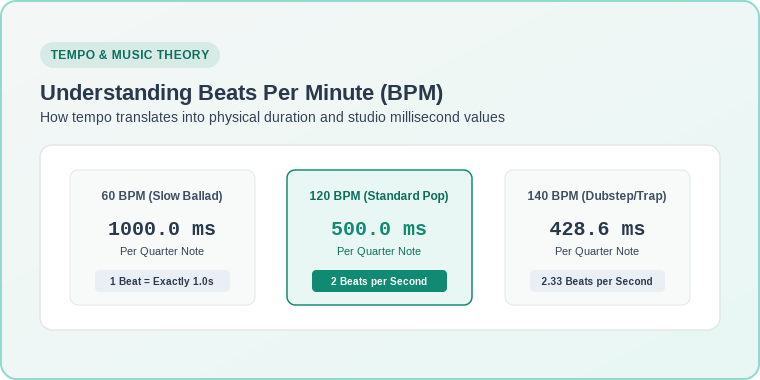
BPM stands for Beats Per Minute. It is the standardized quantitative unit used worldwide to define the tempo (speed or pace) of a piece of music. In standard Western meter (such as common 4/4 time), a "beat" corresponds to one quarter note. Therefore, a song set to 60 BPM plays exactly 60 quarter notes in one minute—or exactly one beat every single second (1,000 ms).
When tempo increases to 120 BPM, beats occur twice as fast, taking 500 ms per beat (60,000 ÷ 120). At 180 BPM, beats fly by every 333.3 ms. This mathematical relationship forms the heartbeat of modern music creation, computer-based sequencing, and audio signal processing.
Time Signatures and the Musical Beat Unit
A common misconception among beginner producers is assuming that one "beat" in BPM always equals one quarter note. In reality, the definition of a beat depends entirely on your song's time signature:
- Simple Meter (4/4, 3/4, 2/4): The bottom number (4) specifies that the quarter note receives the primary beat. In 4/4 time, there are 4 quarter notes per measure. At 120 BPM, each measure spans exactly 2,000 ms (2 seconds).
- Compound Meter (6/8, 9/8, 12/8): In compound meter, beats are divided into triplets. In a 6/8 ballad or slow blues, the listener perceives 2 main pulses per measure, each consisting of a dotted quarter note (three eighth notes). If a DAW project in 6/8 is set to 80 BPM based on the dotted quarter note, each pulse lasts
750 ms, and each eighth note subdivision lasts250 ms. - Cut Time / Alla Breve (2/2): In fast orchestral music, marches, or samba, the half note receives the beat. A song written in 2/2 at 120 BPM has 120 half-note pulses per minute (equivalent to 240 quarter notes per minute).
From Italian Classical Markings to Digital Metronomes
Before electronic clocks and digital workstations existed, composers communicated tempo using descriptive Italian terms. While evocative, these terms allowed wide subjective interpretation:
| Italian Tempo Term | BPM Range | Literal Meaning & Musical Mood |
|---|---|---|
| Grave | 20 – 40 BPM | Extremely slow, solemn, weighty, profound |
| Largo | 40 – 60 BPM | Broad, slow, dignified, expansive |
| Adagio | 66 – 76 BPM | Slow, leisurely, expressive, peaceful |
| Andante | 76 – 108 BPM | At a moderate walking pace, flowing |
| Moderato | 108 – 120 BPM | Moderately paced, restrained, measured |
| Allegro | 120 – 156 BPM | Fast, lively, cheerful, bright |
| Vivace | 156 – 176 BPM | Very fast, vivacious, high-energy |
| Presto | 168 – 200 BPM | Extremely fast, rapid, frantic motion |
| Prestissimo | 200+ BPM | As fast as technically possible, blistering speed |
In 1815, Johann Nepomuk Maelzel patented the mechanical metronome, allowing composers like Ludwig van Beethoven to write specific numerical markings (e.g. M.M. = 120). In today's digital era, DAW clocks maintain sample-accurate tempo synchronization down to fractions of a beat.
Common BPM Ranges Across Popular Genres
Different musical genres naturally gravitate toward specific tempo ranges due to human biological rhythms (such as resting vs elevated heart rates) and the acoustic physics of dance clubs and monitoring environments:
| Musical Genre | Standard BPM Range | Rhythmic Character & Groove |
|---|---|---|
| Dub / Ambient / Downtempo | 60 – 80 BPM | Slow, expansive, spacious; ample room for long reverb tails |
| Boom Bap Hip-Hop | 84 – 96 BPM | Swing-heavy, unquantized kick-snare bounce |
| Modern Trap / Hip-Hop | 130 – 160 BPM (70–80 half-time) | Rolling 1/32 hi-hat rolls over a heavy half-time snare |
| Pop & Contemporary R&B | 90 – 120 BPM | Vocal-centric, steady danceable midtempo pulse |
| House, Deep House & Tech House | 120 – 128 BPM | Four-on-the-floor kick, hypnotic steady club groove |
| Techno & Trance | 130 – 145 BPM | Relentless driving basslines, high-velocity melodic arp throws |
| Drum & Bass / Jungle | 165 – 178 BPM | Fast syncopated breakbeats over sub-bass pressure |
Understanding Double-Time and Half-Time Feels
Perceived musical tempo is heavily influenced by where the snare drum or clap lands in the measure:
- Standard Time: In a 120 BPM house or pop groove, the snare strikes on beats 2 and 4. The song feels like 120 BPM.
- Half-Time Feel: In modern trap or dubstep produced at 140 BPM, the snare only strikes once per bar (on beat 3). Even though the project clock runs at 140 BPM to allow intricate 1/32nd-note hi-hat rolls, the listener's head bobs at 70 BPM.
- Double-Time Feel: Playing the snare on every up-beat (1-and-2-and-3-and-4-and) makes an 80 BPM song suddenly feel like an intense 160 BPM sprint.
DAW Quantization, Swing Percentages & Human Groove
Inside a Digital Audio Workstation, the timeline is divided into discrete mathematical clock pulses known as PPQ (Pulses Per Quarter Note), typically ranging from 96 to 960 PPQ. When you apply 100% hard quantization, note events snap rigidly to the nearest grid line. While this produces machine precision, it can sound robotic and lifeless.
To inject human groove while preserving the master BPM, producers manipulate swing (shuffle). Swing delays alternating off-beat notes (usually 16th notes or 8th notes) to create a relaxed rhythmic bounce:
- 50% Swing (Straight Grid): Even 50/50 division between on-beat and off-beat. Used in Techno, Trance, and four-on-the-floor EDM.
- 54% – 58% Swing (MPC / Hip-Hop Feel): Subtle, relaxed pocket popularized by Roger Linn's Akai MPC60. Gives drums an organic, head-nodding feel without sounding like a waltz.
- 66.7% Swing (Triplet Feel): Off-beat notes are delayed to land exactly on the third note of an eighth-note triplet (2:1 duration ratio). Standard in blues shuffle, classic swing jazz, and UK garage.
How to Detect and Find the BPM of Any Track
If you have an unlabelled sample loop, vocal acapella, or reference song, you can determine its tempo using several reliable techniques:
- Use a Tap Tempo Tool: Tap your spacebar or mouse along with the beat for 4 to 8 measures. Our calculators average the intervals to output the exact BPM.
- Waveform Transient Measurement in your DAW: Highlight exactly one beat (from the start of one kick transient to the next) in your audio editor. Measure its length in milliseconds (T_ms) and calculate:
BPM = 60,000 ÷ T_msusing our MS to BPM Calculator. - DAW Audio Warping / Beatmapping: Modern DAWs (Ableton Live, FL Studio, Logic Pro) feature transient detection engines that analyze rhythmic spikes to calculate the closest whole BPM.
Why BPM Dictates Audio Mixing Decisions
BPM is not just a musical metronome—it directly shapes the acoustic space and frequency headroom of your mix:
- Reverb Pre-Delay: Setting pre-delay as a tempo-synced fraction (like a 1/64 or 1/32 note) preserves vocal intelligibility. Calculate exact values with our Reverb Pre-Delay Calculator.
- Reverb Decay (RT60): Tuning reverb tail lengths to song bars ensures ambient decay clears before the next kick or downbeat hits. Use our Reverb Decay Calculator.
- Delay Repeats: Setting echoes to rhythmic subdivisions (like dotted 1/8 notes) ensures repeats groove in sync with your drum track. Calculate values with the BPM Delay Calculator.
- Compressor Attack & Release: Setting compressor release times in milliseconds to match quarter or eighth notes prevents unnatural pumping and helps tracks breathe. Find every note duration with our BPM to Milliseconds Calculator.
Convert Milliseconds to BPM
Know the millisecond duration of an audio loop or transient gap? Convert it back into exact BPM in one click.
Open MS to BPM Calculator →Frequently Asked Questions
Is a higher BPM always perceived as faster?
Technically yes (more beats occur per minute), but arrangement feel matters. A 150 BPM song in half-time (snare on beat 3) feels slower and heavier than an aggressive 128 BPM track in standard time.
Can a song have decimal BPM values (e.g. 124.5 BPM)?
Yes. Many disco records, live band recordings, and film cue tempos use non-integer BPMs. Our calculators support full decimal precision.
How does BPM translate into milliseconds in a DAW?
Every minute has 60,000 milliseconds. Dividing 60,000 by the BPM gives the exact duration of a quarter note in milliseconds (e.g., 60,000 ÷ 120 = 500 ms).
What is the difference between tempo and BPM?
Tempo is the overarching musical concept of speed or pace (often described historically with terms like Allegro or Andante). BPM is the exact mathematical unit used to quantify that tempo.